Technical Architecture
System Components
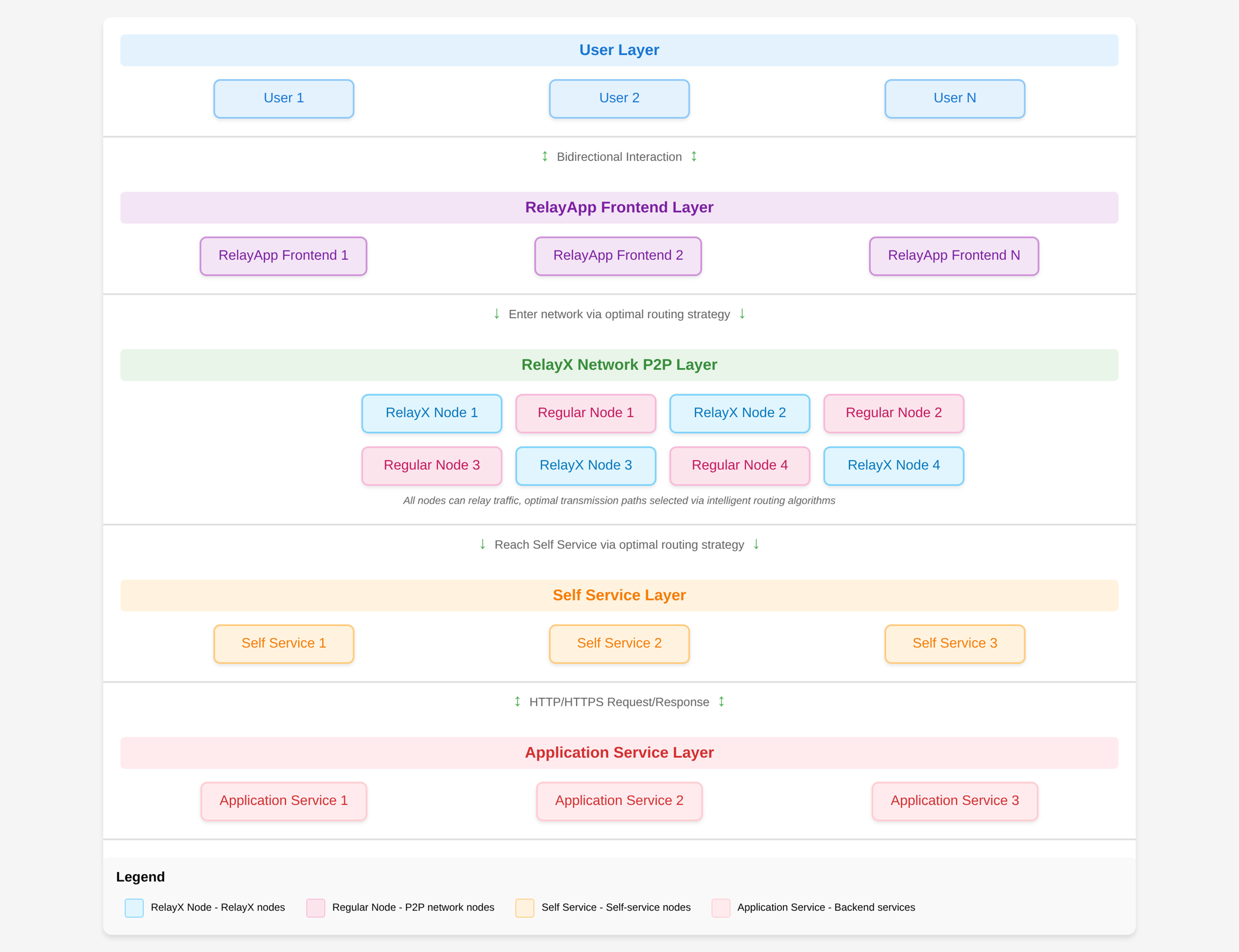
Self Service consists of the following core components, forming a complete decentralized service ecosystem:
RelayApp Frontend
Role: User interaction interface and request initiator
Core Capabilities:
Protocol conversion from HTTP requests to P2P messages
Response result reception and display
Local caching and offline processing
RelayX Node
Role: Efficient routing and forwarding dedicated to Self Service messages
Core Capabilities:
Intelligent routing algorithms optimizing transmission paths
Load balancing avoiding single-node overload
Message encryption and forwarding
Network topology maintenance and optimization
Regular Node
Role: General P2P network node
Core Capabilities:
Participate in message forwarding, increasing network complexity
Provide random routing paths
Enhance network anonymity and censorship resistance
Self Service Node
Role: Bridge between P2P network and traditional application services
Core Capabilities:
Protocol conversion from P2P messages to HTTP requests
Application service access and management
Request verification and permission control
Response data encapsulation and return
Application Service
Role: Actual business logic processing unit
Core Capabilities:
Maintain existing business logic unchanged
Communicate only with Self Service nodes, completely hiding public network addresses
Standard HTTP API interfaces
Network Topology

Request Processing Flow
Complete Call Chain
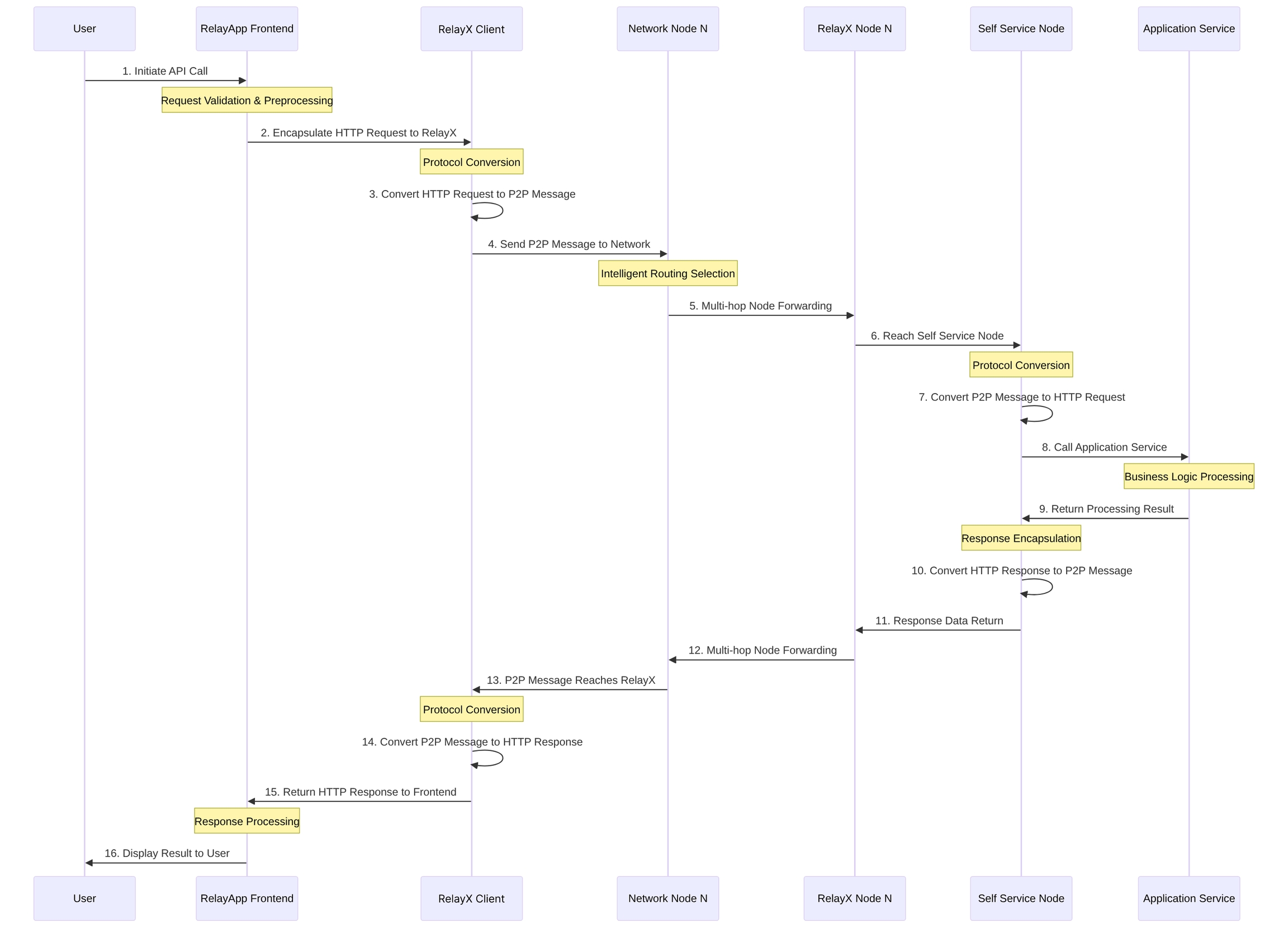
Key Processing Steps
Technical Features and Limitations
Core Features
Latency: Average 1-3 seconds response time, affected by local network
Message Size: Maximum 10 MiB per message, exceeding messages are directly discarded
Consistency: Eventual consistency model, suitable for distributed scenarios
Concurrency: Single node supports medium-low concurrency, overall network can scale horizontally
Application Scenario Analysis
Unsuitable Scenarios
High real-time requirements: Game operations, high-frequency trading, instant messaging
Strong consistency requirements: Bank transfers, inventory deduction, order payments
High concurrency intensive: Flash sales, hotspot data access, high-traffic APIs
Ultra-large data transmission: Video streaming, large file downloads, real-time synchronization
Suitable Scenarios
Asynchronous processing: Message notifications, email sending, background task scheduling
Content management: Article publishing, comment systems, user profile updates
Data synchronization: Configuration updates, state synchronization, log collection
Lightweight interaction: Form submission, data queries, simple CRUD operations
Privacy protection: Anonymous voting, privacy social, sensitive data processing